Skip to content

Filter

Archive

The scientific team of the ‘Deep Wonders of T&T and the Adjacent High Seas’ expedition on-board Schmidt Ocean Institute’s R/V Falkor (too) © Mónika Naranjo González / Schmidt Ocean Institute

Life aboard the Trinidad and Tobago deep-sea expedition

September 9, 2026

For the first time in its history, Trinidad and Tobago's deep sea and adjacent high seas areas were explored by a team led by Caribbeanscientists. Two young scientists onboard, share what a month at sea actually looked like from their side of the boat.

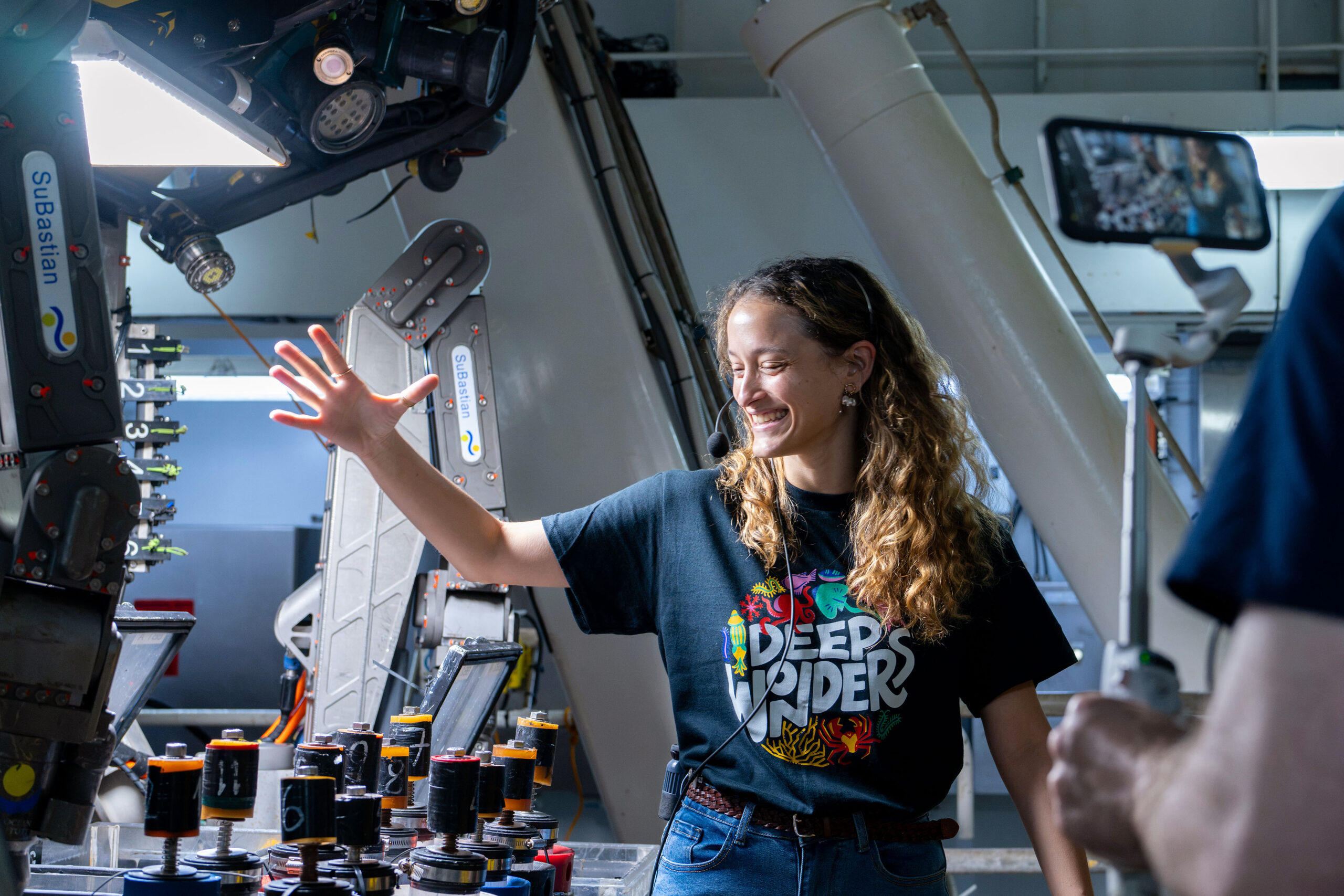
Shauna Edghill during a ship-to-shore event © Schmidt Ocean Institute

Shauna Edghill: Experiences from the Deep Wonders of Trinidad and Tobago deep sea research expedition

September 9, 2026

Before the ROV SuBastian of the Schmidt Ocean Institute's research vessel ever touched the deep waters of Trinidad and Tobago, Shauna Edghill was in classrooms and TV studios telling her country that most of its territory is underwater and almost entirely unexplored. This is what came next: ship-to-shore livestreams, late nights collecting and preserving deep-sea specimens, and a team that became family.

Kyle Foster during the ‘Deep Wonders of T&T and the Adjacent High Seas’ expedition on-board Schmidt Ocean Institute’s R/V Falkor (too) © Schmidt Ocean Institute

Kyle Foster: Experiences from the Deep Wonders of Trinidad and Tobago deep sea research expedition

September 9, 2026

Kyle Foster spent a month at sea aboard Schmidt Ocean Institute's research vessel Falkor (too), exploring the deep waters of Trinidad and Tobago, split between two extremes of deep-sea technology, a multi-million-dollar ROV and a hand-deployable camera built for a fraction of the cost, and helped push the low-cost option to its deepest run yet: 2,240 metres.

Eugenia in the lab © Eugenia Thomas

Exploring the Hidden Forests of the Deep – A Q&A with Eugenia Thomas

October 27, 2025

In this special feature for the Knowledge Hub, Eugenia Thomas, a MPhil candidate at the University of the West Indies, St. Augustine Campus, explores one of our ocean’s most fascinating ecosystems: deep-sea wood falls. These submerged fragments of forest create havens for life on the seafloor, fueling biodiversity and connecting distant habitats. Drawing from her pioneering research in the Caribbean, Eugenia explains how wood falls reveal information on deep-sea connectivity, resilience, and the linkages between land and ocean.

Deep-sea scavengers. Credit: MBARI Creative Commons

Threats to underwater cultural heritage: deep-sea mining

September 25, 2025

While there has been an avalanche of research and voices speaking out about the impacts DSM may have on the marine environment and natural heritage, less attention has been paid to the potential cultural heritage impacts.

Nature’s Hidden Climate Ally – The Deep Sea

September 22, 2025

Covering over 70% of the planet, the ocean is Earth’s largest life-support system, and it has already shielded us from the worst impacts of the climate crisis. It has absorbed more than 90% of the excess heat generated by burning fossil fuels, and about 30% of human-generated carbon dioxide emissions since the 1980s. Without this massive buffer, global temperatures would already be far higher than they are today. But the story doesn’t end at the surface. The deep ocean plays an especially critical role in climate regulation, carbon storage, heat transport, and many ways in which scientists are only beginning to fully understand.

The Challenge of Depth: Describing and Protecting Deep-Sea Species

May 7, 2025

Identifying and describing deep-sea species is a slow, complex process, often taking decades, and without a name, protecting them is even harder. The Senckenberg Ocean Species Alliance (SOSA) is working to change that by accelerating the description and protection of marine invertebrate species, including those from the deep sea, and raising awareness amongst scientists, decision-makers, and the public alike.