
This July, a team of Caribbean scientists explored Trinidad and Tobago’s deep sea and adjacent high seas for the first time in history. This is one of their stories.
This past July, for the first time in its history, scientific exploration of Trinidad and Tobago’s deep sea was led by a team of primarily Trinbagonian scientists and I got invited to be part of that team. As an early-career ocean professional, this was an amazing opportunity to participate in my first deep-sea expedition. But as a Trinbagonian, it represented something much, much larger than myself.
 The scientific team of the ‘Deep Wonders of T&T and the Adjacent High Seas’ expedition on-board Schmidt Ocean Institute’s R/V Falkor (too) © Mónika Naranjo González / Schmidt Ocean Institute
Before this expedition, the vast majority of the scientific knowledge of Trinidad and Tobago’s deep sea came from expeditions led by scientists from outside of the Caribbean and only a very small fraction of the specimens collected remained in-country for use by the local scientific community. This means that historically, the local scientific community has been largely shut out from accessing data about our own backyard. This expedition, with a Trinbagonian Chief Scientist at the helm, represented the first scientific exploration of my country’s waters led by a local scientist, with our needs and interests at the forefront.
We knew that so much of what we were about to explore would be publicly seen for the very first time. T&T’s deep sea makes up 69.1% of our marine space, but the vast majority of our population has very little awareness about what is essentially our largest national biome. Because of this, public outreach was a large focus of the preparation leading up to the expedition.
In the weeks before the expedition, we participated in TV interviews and visited schools and offices across both islands to teach people about the deep sea and invite them to participate in the expedition via the remotely operated vehicle’s (ROV) livestream footage. Outreach continued onboard the vessel with ship-to-shore events, a live video connection between scientists on-board the vessel and on-shore audiences. Audiences got a tour of the labs and working spaces of the vessel and had the opportunity to engage in live Q&A with scientists.
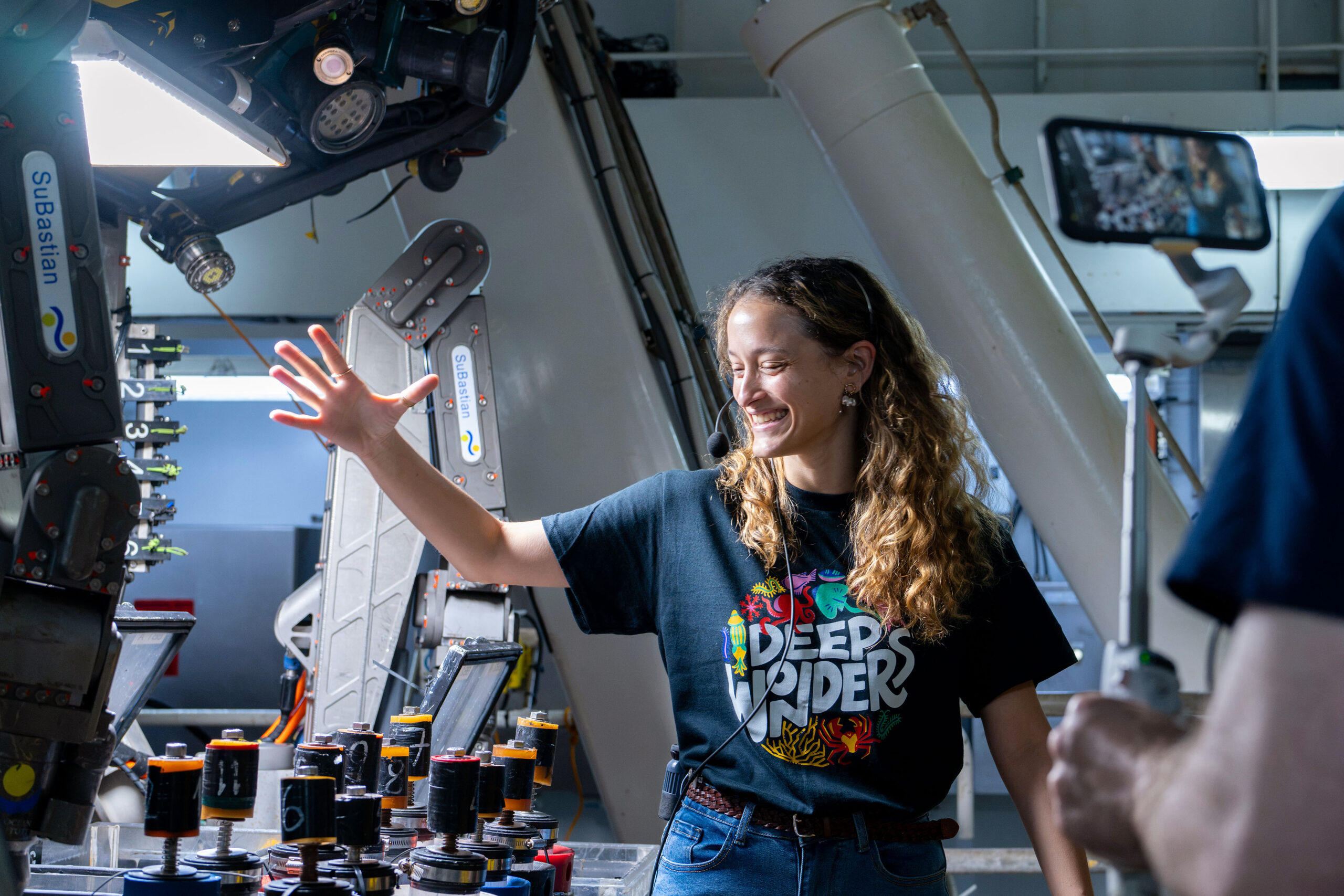 Shauna Edghill during a ship-to-shore event © Mónika Naranjo González / Schmidt Ocean Institute
Daily life on board could look different for each person depending on what team you were assigned. As part of the ROV team, while the ROV was deployed, some of the tasks required included serving as a data logger or a dive lead, directly communicating with the ROV pilots to execute the aims of that particular dive (which could vary between exploration, conducting visual transects, collecting sediment samples, specimen collection, collecting heat probe measurements and collecting water samples).
 Shauna Edghill serving as dive lead in ROV mission control © Mónika Naranjo González / Schmidt Ocean Institute
Once the dive is complete and the ROV gets out of the water and lands on deck, that’s where the real action starts! Several teams coordinated to process all samples that were brought up. This meant transporting them off the ROV into the cold room to wait for processing, assigning each a unique sample ID, and collecting detailed photographs of each specimen before they were subsampled for eDNA and cryopreservation. Then they were packaged, meticulously logged and stored until post-expedition, when they would eventually be transported and displayed at the University of the West Indies’ Zoology Museum. Sediment was collected periodically, requiring us to sieve, preserve, store and log the samples.
 Sediment samples being collected for preservation © Mónika Naranjo González / Schmidt Ocean Institute
Each night there were many opportunities to fill roles at different stations and to learn and practise the methods used. I was able to learn and participate in the cryopreservation, eDNA, sediment processing and museum preservation tasks. Once all specimens were processed and stored, most nights ended in the mess, with a latenight grilled cheese sandwich and stories and jokes passed between each other.
 Some members of the ROV team waiting for ROV SuBastian to land on deck (from left to right: Cherisse Persad, Eugenia Thomas, Kyle Foster, Jaime-Leight Lue Chin, Shauna Edghill and Charlotte Tom © Mónika Naranjo González / Schmidt Ocean Institute
For that month at sea, there were sights that continually had me awestruck. The opportunity to sharpen and expand my knowledge and skillset was invaluable, but what made the experience truly precious to me were my teammates. The atmosphere of collaboration and camaraderie was unlike anything I’ve ever experienced before, working and living together for an entire month toward a common goal. This expedition is just the beginning of locally led exploration of T&T’s own deep-sea backyard.
Read Kyle Foster’s story and find out more about life aboard the Trinidad and Tobago deep-sea expedition.